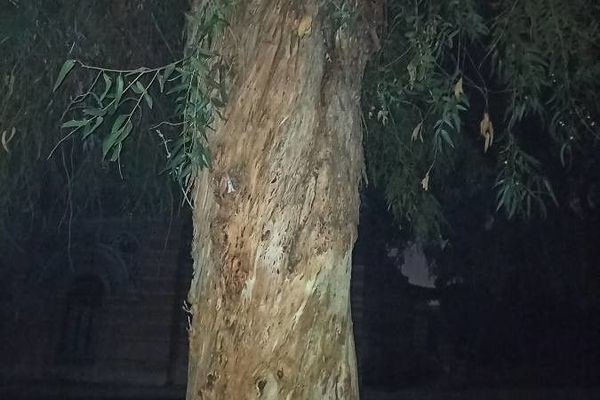
Blue gum
Eucalyptus globulus
Родина: Myrtaceae • Рід: Eucalyptus
БагаторічнаСередньоДекоративна
Bloom Color: White. Main Bloom Time: Early summer, Early spring, Late summer, Late spring, Mid summer, Mid spring. Form: Oval, Upright or erect.
Опис
Industrial Crop: Hydrocarbon Industrial Crop: Medicinal Management: Coppice Management: Standard Minor Global Crop Other Systems: SRC Landscape Uses:Aggressive surface roots possible, Specimen. Prefers a sunny position in a moderately fertile well-drained moisture retentive circum-neutral soil. Succeeds in most soils, tolerating poor and dry soils, especially those low in mineral elements. Established plants are drought tolerant. Plants should not be grown in frost pockets or windy sites. Requires a sheltered position, disliking cold, dry or desiccating winds. Plants are reported to tolerate an annual precipitation of 80 to 160cm and an annual temperature range of ca 16 to 20°C. This species is not very hardy in Britain, tolerating temperatures down to about -5°c and often succumbing to heavy frosts[11, 107, 155]. There is a tree 35 metres tall on the Isle of Man, there are several taller trees in S. Ireland and a tree on the Isle of Wight was 20 metres tall when it was 9 years old from seed. Eucalyptus species have not adopted a deciduous habit and continue to grow until it is too cold for them to do so. This makes them more susceptible to damage from sudden cold snaps. If temperature fluctuations are more gradual, as in a woodland for example, the plants have the opportunity to stop growing and become dormant, thus making them more cold resistant. A deep mulch around the roots to prevent the soil from freezing also helps the trees to survive cold conditions. The members of this genus are remarkably adaptable however, there can be a dramatic increase in the hardiness of subsequent generations from the seed of survivors growing in temperate zones. The Tasmanian blue gum is the most extensively planted eucalypt species in the world with a total of 800,000 ha in dozens of countries. This species is commonly planted in S. Europe, especially in Italy, Spain and Portugal, for timber, soil stabilization and the essential oil in its leaves[50, 61]. Trees have also been planted in marshy areas where they have the ability to reduce the wetness of the land (because they transpire so much water) thus getting rid of mosquitoes that were breeding there. Eucalyptus monocultures are an environmental disaster, they are voracious, allelopathic and encourage the worst possible attitudes to land use and conservation. A very fast growing tree, new growth can be up to 2.5 metres per year[11, 49, 107]. Trees are gross feeders and can severely stunt the growth of nearby plants. Trees are very amenable to coppicing. Plants are shallow-rooting and, especially in windy areas, should be planted out into their permanent positions when small to ensure that they do not suffer from wind-rock. They strongly resent root disturbance and should be container grown before planting out into their permanent position. The flowers are rich in nectar and are a good bee crop[168, 200]. The bruised leaves emit a powerful balsamic smell. This species is the national emblem of Tasmania[156, 167]. Special Features:Fragrant foliage, Not North American native, Invasive, Inconspicuous flowers or blooms. Carbon Farming Industrial Crop: Hydrocarbon Materials, chemicals and energy include bioplastics, rubber, biomass products gasoline, jet fuel, diesel, butane, propane, biogas. Plants are usually resprouting plants and saps. Industrial Crop: Medicinal Most pharmaceuticals are synthesized from petroleum but 25% of modern medicines are based on plants. Management: Coppice Cut to the ground repeatedly - resprouting vigorously. Non-destructive management systems maintaining the soil organic carbon. Management: Standard Plants grow to their standard height. Harvest fruit, seeds, or other products. Non-Destructive management systems. Minor Global Crop These crops are already grown or traded around the world, but on a smaller scale than the global perennial staple and industrial crops, The annual value of a minor global crop is under $1 billion US. Examples include shea, carob, Brazil nuts and fibers such as ramie and sisal. Other Systems: SRC Short-rotation coppice. References Carbon Farming Information and Carbon Sequestration Information Temperature Converter Type a value in the Celsius field to convert the value to Fahrenheit: Celsius Fahrenheit: The PFAF Bookshop Plants For A Future have a number of books available in paperback and digital form. Book titles include Edible Plants , Edible Perennials , Edible Trees , Edible Shrubs , Woodland Gardening , and Temperate Food Forest Plants . Our new book is Food Forest Plants For Hotter Conditions (Tropical and Sub-Tropical) . Shop Now
Походження та ареал
AUSTRALASIA: Australia (Tasmania, New South Wales (east), Victoria)
Корисні властивості
Edible Parts: Edible Uses: Condiment An essential oil from the fresh or dried leaves is used as a flavouring in sweets, baked goods, ice cream etc[177, 183]. References More on Edible Uses
Поради
Seed - surface sow February/March in a sunny position in a greenhouse[11, 78, 134]. Species that come from high altitudes appreciate 6 - 8 weeks cold stratification at 2°c. Pot up the seedlings into individual pots as soon as the second set of seed leaves has developed, if left longer than this they might not move well. Plant out into their permanent positions in early summer and give them some protection from the cold in their first winter. The seed can also be sown in June, the young trees being planted in their final positions in late spring of the following year. The seed has a long viability.