Опис
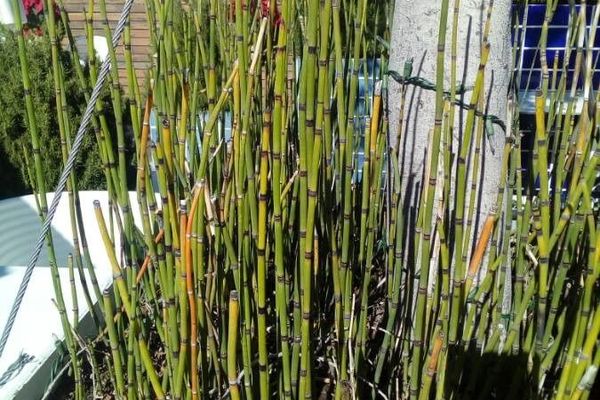
Tall horsetail is more useful as a utilitarian plant than a food source. Growing Conditions: Prefers wet soils and full sun. Habitat & Range: Found in wetlands and along streams in temperate and boreal regions. Size & Landscape Performance: Tall, upright, and architectural; spreads aggressively. Cultivation (Horticulture): Sometimes used ornamentally, but can be invasive. Pests & Problems: Few pests; difficult to control. Identification & Habit: Unbranched, jointed green stems with rough texture and dark-banded nodes. Pollinators; Reproduces via spores, not pollinators. Tall horsetail, Equisetum hyemale, belongs to the horsetail family (Equisetaceae). Commonly called western horsetail or scouring rush. It grows in USDA Zones 3–10 and typically reaches 40–150 cm tall with spreading rhizomes. Prefers a moist soil with a pH between 6.5 and 7.5. Plants are hardy to about -30°c. The stems of this species were once exported to Britain in quantity from Holland so that they could be used as an abrasive for cleaning pots and pans. Plants have a deep and penetrating root system and can be invasive. If grown in the garden they are best kept in bounds by planting them in a large container which can be sunk into the ground. Special Features:North American native, Invasive, Naturalizing, Wetlands plant. In garden design, as well as the above-ground architecture of a plant, root structure considerations help in choosing plants that work together for their optimal soil requirements including nutrients and water. The root pattern is fleshy. Thick or swollen - fibrous or tap root [2-1]. References Carbon Farming Information and Carbon Sequestration Information Temperature Converter Type a value in the Celsius field to convert the value to Fahrenheit: Celsius Fahrenheit: The PFAF Bookshop Plants For A Future have a number of books available in paperback and digital form. Book titles include Edible Plants , Edible Perennials , Edible Trees , Edible Shrubs , Woodland Gardening , and Temperate Food Forest Plants . Our new book is Food Forest Plants For Hotter Conditions (Tropical and Sub-Tropical) . Shop Now
Походження та ареал
TEMPERATE ASIA: Turkey, Russian Federation-Ciscaucasia (Ciscaucasia), Armenia, Azerbaijan, Georgia, Russian Federation-Western Siberia (Western Siberia), Russian Federation-Eastern Siberia (Eastern Siberia), Russian Federation (Altay), Kazakhstan, Kyrgyzstan, Tajikistan, Russian Federation (Habarovskij kraj, Primorye, Amur), China (Gansu Sheng, Hebei Sheng, Heilongjiang Sheng, Jilin Sheng, Liaoning Sheng, Nei Mongol Zizhiqu, Ningxia Huizi Zizhiqu, Qinghai Sheng, Shaanxi Sheng, Shanxi Sheng, Xinj
Корисні властивості
Edible Parts: Root Shoots Stem Edible Uses: Tall horsetail is a rigid, reed-like species lacking the distinct fertile/sterile stem separation seen in field horsetail. It is less useful as food due to its coarse structure but shares similar properties [2-3]. Edibility Summary: Young shoots and rhizomes are technically edible when cooked, but the quality is poor, and opportunities for use are limited [2-3]. Edible Uses & Rating: This species ranks low as a food plant. Its tough texture and limited edible stage reduce its value [2-3]. Taste, Processing & Kitchen Notes: When harvested very young, shoots may be softened by boiling, but they quickly become fibrous and hollow. Flavor is mild but unremarkable. Seasonality (Phenology): Growth begins in spring, but edible stages are extremely brief and often missed. Safety & Cautions (Food Use): Contains the same compounds as other horsetails, including thiaminase. Cooking is essential, and intake should be limited. Harvest & Processing Workflow: Harvest only the youngest shoots before hardening. Boil thoroughly. Rhizomes can be used similarly to other species [2-3]. Cultivar/Selection Notes: No known cultivars for food use. Look-Alikes & Confusion Risks: Easily identified by its tall, unbranched, segmented stems with dark-banded sheaths [2-3]. Traditional/Indigenous Use Summary: Used more commonly for scouring and medicinal purposes than as food [2-3]. Strobil (the fertile shoots in spring) - cooked. An asparagus substitute. Caution is advised, see the notes above on toxicity. Roots - dried and then cooked. A source of starch. Caution is advised, see the notes above on toxicity. A further report says that the peeled stems, base of the plant, root and tubers were eaten raw by the N. American Indians, the report went on to say that this may be inadvisable. References More on Edible Uses
Поради
Spores - best collected as soon as they are ripe in the spring and surface-sown immediately on a sterile compost. Keep moist and pot up as soon as the plants are large enough to handle. Very difficult. Division. The plants usually spread very freely when well sited and should not really need any assistance.