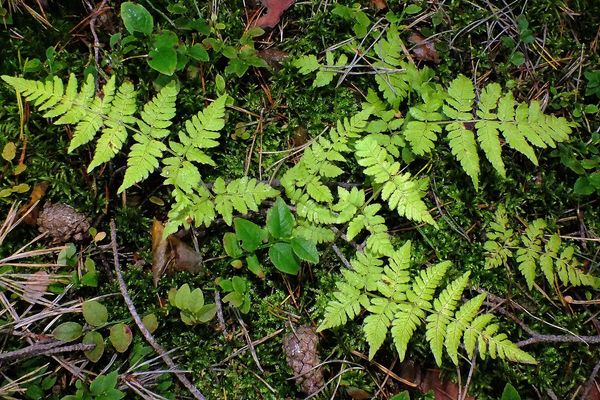
Spinulose woodfern
Dryopteris carthusiana
Родина: Polypodiaceae • Рід: Dryopteris
БагаторічнаСередньоДекоративна
Form: Upright or erect.
Опис
Landscape Uses:Foundation, Ground cover, Massing, Woodland garden. Prefers an acid to neutral soil, succeeding in ordinary fertile soil in a shady position[175, 200]. Requires permanently moist conditions at its roots. A very ornamental plant, it is often evergreen in mild winters. Plants spread slowly at the rootstock. Members of this genus are rarely if ever troubled by browsing deer. Special Features:Attractive foliage, Not North American native, Naturalizing, There are no flowers or blooms. References Carbon Farming Information and Carbon Sequestration Information Temperature Converter Type a value in the Celsius field to convert the value to Fahrenheit: Celsius Fahrenheit: The PFAF Bookshop Plants For A Future have a number of books available in paperback and digital form. Book titles include Edible Plants , Edible Perennials , Edible Trees , Edible Shrubs , Woodland Gardening , and Temperate Food Forest Plants . Our new book is Food Forest Plants For Hotter Conditions (Tropical and Sub-Tropical) . Shop Now
Походження та ареал
TEMPERATE ASIA: Lebanon, Turkey, Armenia, Azerbaijan, Georgia NORTHERN AMERICA: Canada (Québec, Nova Scotia, Ontario, Prince Edward Island, New Brunswick, Newfoundland and Labrador, Saskatchewan, Manitoba, British Columbia), United States (Connecticut, Indiana, Maine, Massachusetts, Michigan, New Hampshire, New Jersey, Ohio, Pennsylvania, Rhode Island, Vermont, West Virginia, Iowa, Minnesota, Missouri, Nebraska, North Dakota, Illinois, Wisconsin, Idaho, Montana, Washington, Arkansas, Delaware, K
Корисні властивості
Edible Parts: Leaves Root Edible Uses: Root - baked. Some caution is advised, see notes above on toxicity. Old leafstalks on the underground stems can be roasted, peeled and the inner portion eaten. Young curled fronds, harvested as they are developing in the spring, can be boiled and eaten like asparagus. References More on Edible Uses
Поради
Spores - can be sown at any time of the year in a greenhouse. Surface sow on a sterilised compost and keep moist, possibly by placing the pot in a plastic bag. Germinates in 1 - 3 months at 20°c. Pot up small clumps of the plants when they are large enough to handle and grow on in a shady part of the greenhouse until large enough to plant out. Division in spring. Larger clumps can be replanted direct into their permanent positions, though it is best to pot up smaller clumps and grow them on in a cold frame until they are rooting well. Plant them out in the spring.