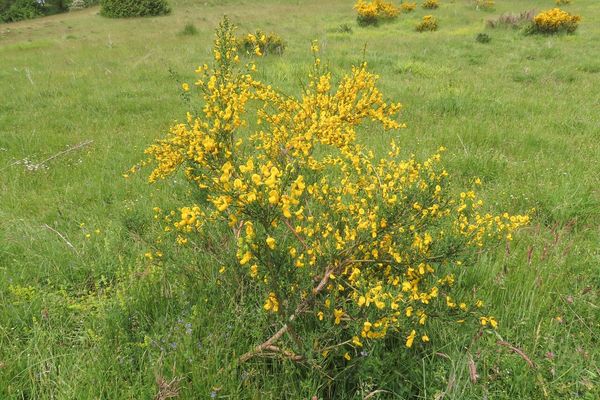
Опис
Agroforestry Services: Nitrogen Management: Coppice Minor Global Crop Landscape Uses:Border, Container, Foundation, Massing, Specimen. Succeeds in most soils, preferring a fairly good but not rich soil. Prefers a poor well-drained soil. Succeeds in slightly acid, neutral and limy soils but dislikes shallow soils over chalk. Plants are strongly calcifuge according to other reports and intolerant of a pH much above 6.5[17, 186]. Prefers a sunny position but tolerates some shade[11, 14, 17]. Plants succeed in exposed conditions, and are very tolerant of maritime exposure[4, K]. Plants have a deep root system, they are very drought tolerant once established and grow well on dry banks[4, 11]. Tolerates a smoky atmosphere, growing well in polluted areas. Plants are hardy to about -20°c. A number of named forms have been developed for their ornamental value. New leaves are formed in April but these soon drop off the plant, photosynthesis being carried out by means of the green stems. Very tolerant of cutting, it regenerates quickly from the base. Plants are usually killed by fire but the seeds quickly germinate after the fire and rapidly become established. A good bee plant and food plant for many caterpillars[24, 30, 46], it provides the food for the larvae of the green hairstreak butterfly. Ants are attracted to the seeds, feeding on the juicy attachment that holds them to the pods and thus distributing the seed. Dislikes root disturbance, especially when more than 20cm tall. It is best to plant out into their permanent positions as early as possible. This species has a symbiotic relationship with certain soil bacteria, these bacteria form nodules on the roots and fix atmospheric nitrogen. Some of this nitrogen is utilized by the growing plant but some can also be used by other plants growing nearby. Special Features:Not North American native, Naturalizing, Fragrant flowers, Attractive flowers or blooms. Seeds are typically harvested in late summer to early autumn when the seed pods are dry. Broom generally flowers in spring, with peak blooming depending on the species and local climate. Carbon Farming Agroforestry Services: Nitrogen Plants that contribute to nitrogen fixation include the legume family – Fabaceae. Management: Coppice Cut to the ground repeatedly - resprouting vigorously. Non-destructive management systems maintaining the soil organic carbon. Minor Global Crop These crops are already grown or traded around the world, but on a smaller scale than the global perennial staple and industrial crops, The annual value of a minor global crop is under $1 billion US. Examples include shea, carob, Brazil nuts and fibers such as ramie and sisal. References Carbon Farming Information and Carbon Sequestration Information Temperature Converter Type a value in the Celsius field to convert the value to Fahrenheit: Celsius Fahrenheit: The PFAF Bookshop Plants For A Future have a number of books available in paperback and digital form. Book titles include Edible Plants , Edible Perennials , Edible Trees , Edible Shrubs , Woodland Gardening , and Temperate Food Forest Plants . Our new book is Food Forest Plants For Hotter Conditions (Tropical and Sub-Tropical) . Shop Now
Походження та ареал
EUROPE: Denmark, United Kingdom, Ireland, Norway, Sweden, Austria, Belgium, Switzerland, Czech Republic, Germany, Hungary, Netherlands, Poland, Slovakia, Belarus, Lithuania, Latvia, Moldova (north), Ukraine (west), Greece, Italy (incl. Sardinia, Sicily), Romania, Slovenia, Spain, France (incl. Corsica), Portugal AFRICA: Spain (Canarias)
Корисні властивості
Edible Parts: Flowers Edible Uses: Coffee Condiment The flower buds are pickled and used as a substitute for capers[4, 46, 183, 244]. They can also be added to salads. Some caution is advised, see the notes above on toxicity. The tender green tops of the plant have been used like hops to give a bitter flavour to beer and to render it more intoxicating[4, 183]. The roasted seed is a coffee substitute[2, 4, 115, 183]. References More on Edible Uses
Поради
Seed - best sown as soon as it is ripe in the autumn in a cold frame. Pre-soak stored seed for 24 hours in warm water then cold stratify for 1 month and sow in a cold frame. The seed usually germinates in 4 weeks at 20°c[98, 113]. Seedlings should be potted up as soon as possible since plants quickly become intolerant of root disturbance. Plant them out into their permanent positions in late summer if they have made sufficient growth, otherwise in late spring of the following year[K]. The seed has a long viability. Seed can also be sown in situ as soon as it is ripe in the late summer and autumn. Cuttings of half-ripe wood, 4 - 7 cm with a heel, August in a frame. Produces roots in the spring. Pot up as soon as possible. Cuttings of mature wood, October/November in a frame. Layering.