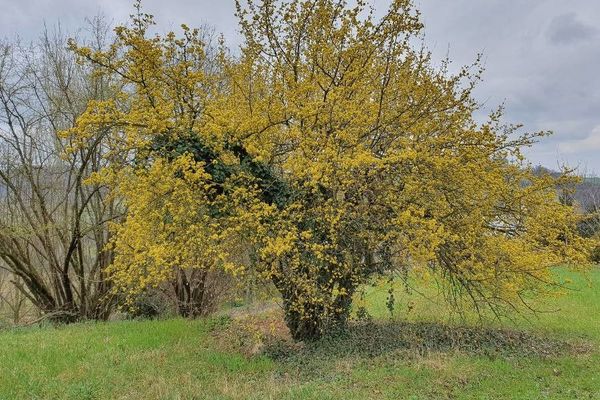
Cornelian-cherry
Cornus mas
Родина: Cornaceae • Рід: Cornus
БагаторічнаСередньоДекоративна
Bloom Color: Yellow. Main Bloom Time: Early spring, Early winter, Late winter, Mid spring, Mid winter. Form: Rounded.
Опис
Landscape Uses:Border, Firewood, Pest tolerant, Hedge, Screen, Specimen, Woodland garden. An easily grown plant, it succeeds in any soil of good or moderate fertility, ranging from acid to shallow chalk. Grows well in heavy clay soils. Prefers a moist soil and a sunny position but also succeeds in light shade. Plants are fairly wind resistant[K]. Plants grow and crop well in pots. A very hardy plant, tolerating temperatures down to about -25°c. At one time the cornelian cherry was frequently cultivated for its edible fruit, though it has fallen into virtual disuse as a fruit crop in most areas. It is still being cultivated in parts of C. Europe and there are some named varieties. 'Macrocarpa' has larger fruits than the type. 'Nana' is a dwarf form, derived from a yellow-fruited clone. 'Variegata' has been seen on a number of occasions with very large crops of fruit, even in years when the type species has not fruited well[K]. 'Jolico' has well-flavoured fruits 3 times larger than the species. There are also a number of cultivars with yellow, white and purplish fruit. Seedlings can take up to 20 years to come into fruit. Plants produced from cuttings come into fruit when much younger, though they do not live as long as the seedlings. A very ornamental plant it flowers quite early in the year and is a valuable early food for bees[13, 108]. Plants in this genus are notably resistant to honey fungus.Special Features:Attracts birds, Not North American native, Attractive flowers or blooms. The plant is heat tolerant in zones 8 through 5. (Plant Hardiness Zones show how well plants withstand cold winter temperatures. Plant Heat Zones show when plants would start suffering from the heat. The Plant Heat Zone map is based on the number of "heat days" experienced in a given area where the temperature climbs to over 86 degrees F (30°C). At this temperature, many plants begin to suffer physiological damage. Heat Zones range from 1 (no heat days) to 12 (210 or more heat days). For example Heat Zone. 11-1 indicates that the plant is heat tolerant in zones 11 through 1.) For polyculture design as well as the above-ground architecture (form - tree, shrub etc. and size shown above) information on the habit and root pattern is also useful and given here if available. The plant growth habit is a standard with a non-suckering single trunk [1-2]. In garden design, as well as the above-ground architecture of a plant, root structure considerations help in choosing plants that work together for their optimal soil requirements including nutrients and water. The root pattern is branching: a heart root, dividing from the crown into several primary roots going down and out [2-1]. References Carbon Farming Information and Carbon Sequestration Information Temperature Converter Type a value in the Celsius field to convert the value to Fahrenheit: Celsius Fahrenheit: The PFAF Bookshop Plants For A Future have a number of books available in paperback and digital form. Book titles include Edible Plants , Edible Perennials , Edible Trees , Edible Shrubs , Woodland Gardening , and Temperate Food Forest Plants . Our new book is Food Forest Plants For Hotter Conditions (Tropical and Sub-Tropical) . Shop Now
Походження та ареал
TEMPERATE ASIA: Armenia, Azerbaijan, Ciscaucasia, Dagestan, Georgia, Russian Federation, Russian Federation-Ciscaucasia,Turkey. EUROPE: Czechoslovakia (Czech Republic and Slovakia), Austria, Belgium, Switzerland, Germany, Hungary, Moldova, Ukraine (incl. Krym), Former Yugoslavia, Albania, Bulgaria, Greece, Italy, Romania, France,
Корисні властивості
Edible Parts: Fruit Oil Oil Edible Uses: Coffee Oil Oil Fruit - raw, dried or used in preserves[2, 3, 7, 9, 13, 183]. Juicy, with a nice acid flavour. The fully ripe fruit has a somewhat plum-like flavour and texture and is very nice eating, but the unripe fruit is rather astringent[K]. It is rather low in pectin and so needs to be used with other fruit when making jam. At one time the fruit was kept in brine and used like olives. The fruit is a reasonable size, up to 15mm long, with a single large seed[K]. A small amount of edible oil can be extracted from the seeds. Seeds are roasted, ground into a powder and used as a coffee substitute. References More on Edible Uses
Поради
Seed - best sown as soon as it is ripe in a cold frame or in an outdoors seedbed if there is sufficient seed[80, 113]. The seed must be separated from the fruit flesh since this contains germination inhibitors[80, 164]. Stored seed should be cold stratified for 3 - 4 months and sown as early as possible in the year. Scarification may also help as may a period of warm stratification before the cold stratification[80, 164]. Germination, especially of stored seed, can be very slow, taking 18 months or more. Prick out the seedlings of cold-frame sown seeds into individual pots as soon as they are large enough to handle and grow the plants on for their first winter in a greenhouse, planting out in the spring after the last expected frosts. Cuttings of half-ripe side shoots, July/August in a frame. Cuttings of mature wood of the current year's growth, taken with a heel if possible, autumn in a cold frame. High percentage. Layering of new growth in June/July. Takes 9 months.