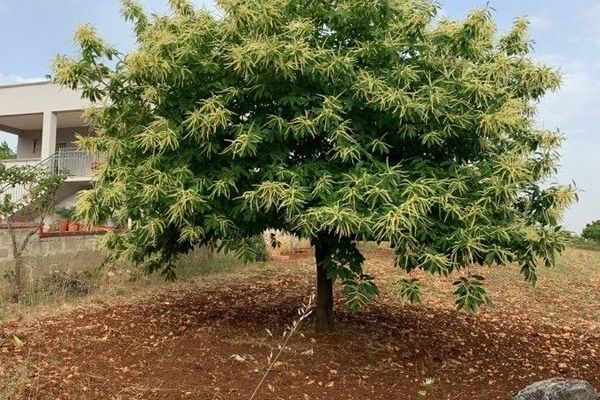
European chestnut
Castanea sativa
Родина: Fagaceae • Рід: Castanea
БагаторічнаСередньоДекоративна
Chestnuts require cross-pollination between at least two different cultivars or seedlings — plant them within 50 feet of each other for reliable nut set. American chestnut was devastated by blight, so choose blight-resistant Chinese, European, or hybrid selections (such as Dunstan Chestnuts). Trees
Опис
Global Crop Industrial Crop: Biomass Industrial Crop: Tannin Management: Standard Staple Crop: Balanced carb Prefers a good well-drained slightly acid loam in a sunny position but it also succeeds in dry soils[1, 11, 200, 238]. Once established, it is very drought tolerant[1, 11, 200, 238]. Plants are very tolerant of highly acid, infertile dry sands. Averse to calcareous soils but succeeds on harder limestones[11, 200]. Tolerates maritime exposure though it is slower growing in such a position. The dormant plant is very cold-hardy in Britain, though the young growth in spring, even on mature plants, is frost-tender[K]. The sweet chestnut is often cultivated for its edible seed in warm temperate zones, there are several named varieties[46, 183]. Both 'Marron de Lyon' and 'Paragon' produce fruits with a single large kernel (rather than 2 - 4 smaller kernels) and so are preferred for commercial production. Castanea sativa x crenata: The hybrid sweet chestnut ‘Marigoule’ is a good choice If you only want to grow one tree as Marigoule is a partly self-fertile cultivar. Sweet chestnuts require a warm dry summer in order to ripen their fruit properly in Britain and even then these seeds are generally inferior in size and quality to seeds grown in continental climates. Most species in this genus are not very well adapted for the cooler maritime climate of Britain, preferring hotter summers, but this species grows well here[11, 200]. An excellent soil-enriching understorey in pine forests. Flowers are produced on wood of the current year's growth and they are very attractive to bees.. Plants are fairly self-sterile. They hybridize freely with other members of this genus. At one time this tree was widely grown in coppiced woodlands for its wood, but the practise of coppicing has fallen into virtual disuse. Trees regrow very quickly after being cut down, producing utilizable timber every 10 years. This species is not often seen in Cornwall though it grows very well there. Trees take 30 years from seed to come into bearing. Plants in this genus are notably resistant to honey fungus. In garden design, as well as the above-ground architecture of a plant, root structure considerations help in choosing plants that work together for their optimal soil requirements including nutrients and water. The root pattern is fleshy. Thick or swollen - fibrous or tap root [2-1]. Carbon Farming Global Crop These crops are already grown or traded around the world. The annual value of each is more than $1 billion US Examples include coconuts, almonds, and bananas. Industrial Crop: Biomass Three broad categories: bamboos, resprouting woody plants, and giant grasses. uses include: protein, materials (paper, building materials, fibers, biochar etc.), chemicals (biobased chemicals), energy - biofuels Industrial Crop: Tannin Occur generally in the roots, wood, bark, leaves, and fruit of many plants. Used in tanning leather, dyeing fabric, making ink, and medical applications. Management: Standard Plants grow to their standard height. Harvest fruit, seeds, or other products. Non-Destructive management systems. Staple Crop: Balanced carb (0-15 percent protein, 0-15 percent oil, with at least one over 5 percent). The carbohydrates are from either starch or sugar. Annuals include maize, wheat, rice, and potato. Perennials include chestnuts, carob, perennial fruits, nuts, cereals, pseudocereals, woody pods, and acorns. References Carbon Farming Information and Carbon Sequestration Information Temperature Converter Type a value in the Celsius field to convert the value to Fahrenheit: Celsius Fahrenheit: The PFAF Bookshop Plants For A Future have a number of books available in paperback and digital form. Book titles include Edible Plants , Edible Perennials , Edible Trees , Edible Shrubs , Woodland Gardening , and Temperate Food Forest Plants . Our new book is Food Forest Plants For Hotter Conditions (Tropical and Sub-Tropical) . Shop Now
Походження та ареал
TEMPERATE ASIA: Armenia, Azerbaijan, Ciscaucasia, Georgia, Russian Federation-Ciscaucasia,Turkey. EUROPE: Hungary (west), Albania, Bulgaria, Bosnia and Herzegovina, Greece, Croatia, Italy (incl. Sardinia, Sicily), North Macedonia, Montenegro, Serbia, Slovenia, AFRICA: Algeria (north), Morocco, Tunisia.
Корисні властивості
Edible Parts: Seed Edible Uses: Coffee Sweetener Seed - raw or cooked[2, 4, 5, 9, 12, 34]. A somewhat astringent taste raw, it improves considerably when cooked and is delicious baked with a floury texture and a flavour rather like sweet potatoes[K]. The seed is rich in carbohydrates, it can be dried, then ground and used as a flour in breads, puddings, as a thickener in soups etc[7, 63, 132, 183]. The roasted seed can be used as a coffee substitute. A sugar can be extracted from the seed. References More on Edible Uses
Поради
Seed - where possible sow the seed as soon as it is ripe in a cold frame or in a seed bed outdoors. The seed must be protected from mice and squirrels. The seed has a short viability and must not be allowed to become dry. It can be stored in a cool place, such as the salad compartment of a fridge, for a few months if it is kept moist, but check regularly for signs of germination. The seed should germinate in late winter or early spring. If sown in an outdoor seedbed, the plants can be left in situ for 1 - 2 years before planting them out in their permanent positions. If grown in pots, the plants can be put out into their permanent positions in the summer or autumn, making sure to give them some protection from the cold in their first winter[K].