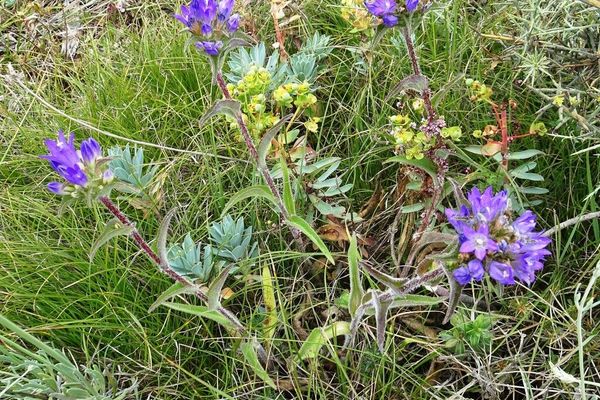
Dane's-blood
Campanula glomerata
Родина: Campanulaceae • Рід: Campanula
БагаторічнаСередньоДекоративна
Bloom Color: Purple, White. Main Bloom Time: Early summer, Late spring, Mid summer. Form: Upright or erect
Опис
Landscape Uses:Border, Container, Foundation, Massing, Rock garden, Specimen. Prefers a moist but well-drained rich sandy loam and a neutral or alkaline soil in sun or partial shade[1, 200]. Succeeds in any well-drained soil in sun or partial shade. A very ornamental plant, there are several named forms. This is a very vigorous species and can be invasive, spreading by means of its creeping rootstock, when well suited to its site. Members of this genus are rarely if ever troubled by browsing deer. The species in this genus do not often hybridize and so seed can generally be relied upon to come true. The plants are self-fertile. Special Features:Not North American native, Invasive, Attracts butterflies, Suitable for cut flowers. The plant is heat tolerant in zones 8 through 1. (Plant Hardiness Zones show how well plants withstand cold winter temperatures. Plant Heat Zones show when plants would start suffering from the heat. The Plant Heat Zone map is based on the number of "heat days" experienced in a given area where the temperature climbs to over 86 degrees F (30°C). At this temperature, many plants begin to suffer physiological damage. Heat Zones range from 1 (no heat days) to 12 (210 or more heat days). For example Heat Zone. 11-1 indicates that the plant is heat tolerant in zones 11 through 1.) For polyculture design as well as the above-ground architecture (form - tree, shrub etc. and size shown above) information on the habit and root pattern is also useful and given here if available. The plant growth habit is a clumper with limited spread [1-2]. References Carbon Farming Information and Carbon Sequestration Information Temperature Converter Type a value in the Celsius field to convert the value to Fahrenheit: Celsius Fahrenheit: The PFAF Bookshop Plants For A Future have a number of books available in paperback and digital form. Book titles include Edible Plants , Edible Perennials , Edible Trees , Edible Shrubs , Woodland Gardening , and Temperate Food Forest Plants . Our new book is Food Forest Plants For Hotter Conditions (Tropical and Sub-Tropical) . Shop Now
Походження та ареал
TEMPERATE ASIA: China, Eastern Siberia, Heilongjiang Sheng, Iraq (north), Japan, Jilin Sheng, Kazakhstan, Korea, Kumamoto, Liaoning Sheng (east), Mongolia, Nei Mongol Zizhiqu (northeast), Ôita, Russian Federation-Eastern Siberia, Russian Federation-Western Siberia, Turkey, Western Siberia, Xinjiang Uygur Zizhiqu,Iran. EUROPE: Denmark, Finland, United Kingdom (U.K.), Sweden, Austria, Belgium, Switzerland, Czech Republic, Germany, Hungary, Netherlands, Poland, Slovakia, Russian Federation-European
Корисні властивості
Edible Parts: Flowers Leaves Edible Uses: Leaves - raw or cooked. A mild flavour with a pleasant sweetness, it can be used as a major ingredient in salads[K]. Flowers - raw[K]. Beautiful to look at, they have a pleasant sweetness and make a very attractive decoration to a salad[K]. References More on Edible Uses
Поради
Seed - surface sow spring in a cold frame. The seed usually germinates in 2 - 4 weeks at 18°c. Very easy. When they are large enough to handle, prick the seedlings out into individual pots and grow them on in a cold frame for at least their first winter. Plant them out into their permanent positions in late spring or early summer, after the last expected frosts. Basal cuttings in spring. Very easy. Harvest the shoots when they are about 10 - 15cm long with plenty of underground stem. Pot them up into individual pots and keep them in light shade in a cold frame or greenhouse until they are rooting well. Plant them out in the summer. Division in spring or autumn. Very easy, larger clumps can be replanted direct into their permanent positions, though it is best to pot up smaller clumps and grow them on in a cold frame until they are rooting well. Plant them out in the summer or following spring.