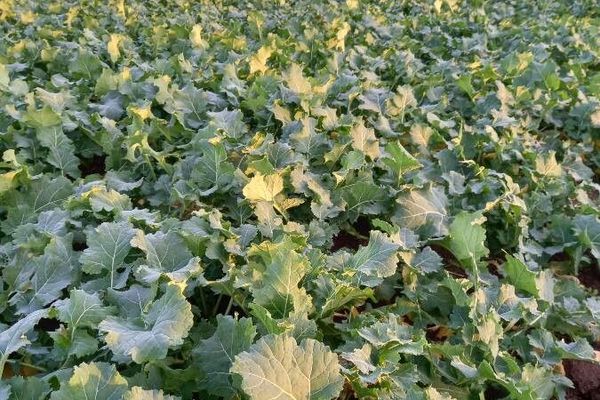
Rape
Brassica napus
Родина: Brassicaceae • Рід: Brassica
БагаторічнаСередньоДекоративна
Broadcast at about 0.25-0.5 lb per 1,000 sq ft and rake to cover 0.25-0.5 inch deep in a firm seedbed. Winter-type oilseed rape develops a deep taproot that breaks up compacted subsoil and scavenges nitrogen and sulfur. Overwintering plants bolt and flower in spring, providing early forage for polli
Опис
Succeeds in full sun in a well-drained fertile preferably alkaline soil. Succeeds in any reasonable soil. Prefers a heavy soil and cool moist conditions[16, 20]. Sunny days and cool nights are favourable for plant growth whilst dry weather at harvest time is essential. Colza is reported to tolerate an annual precipitation of 30 to 280cm, an annual average temperature range of 5 to 27°C and a pH in the range of 4.2 to 8.2. Very young plants are susceptible to cold damage, -4°C either killing or injuring seedlings, whereas -2°C has no affect when the plants are more than one month old. Brassica napus is an aggregate species, probably derived through cultivation. It is thought that crosses of Brassica oleracea subsp. oleracea with B. rapa gave rise to the subsp. B. napus pabularia, from which subsp. napus and subsp. rapifera and other cvs were derived. The aggregate species includes forms with swollen edible roots (B. napus napobrassica, the garden swede), forms grown for their oil-rich seeds (B. napus napus, the oilseed rape), forms grown for their edible leaves (B. napus pabularia, the rape kales) whilst the form grown as a green manure is B. napus arvensis. All these forms are treated separately here. The oil obtained from the seed is high in erucic acid and glucosinolates, both of which have anti-nutritional properties. Cultivars have been developed that have a low content of these items and are therefore suitable for food. Colza is 70% self-pollinating and 30% cross-pollinated. Even if wind and insects are absent, seed are still produced. Yield increases with honeybees. The growth of this plant is inhibited by field mustard and hedge mustard growing nearby[18, 20]. This species is closely related to B. rapa. References Carbon Farming Information and Carbon Sequestration Information Temperature Converter Type a value in the Celsius field to convert the value to Fahrenheit: Celsius Fahrenheit: The PFAF Bookshop Plants For A Future have a number of books available in paperback and digital form. Book titles include Edible Plants , Edible Perennials , Edible Trees , Edible Shrubs , Woodland Gardening , and Temperate Food Forest Plants . Our new book is Food Forest Plants For Hotter Conditions (Tropical and Sub-Tropical) . Shop Now
Походження та ареал
Coming Soon
Корисні властивості
Edible Parts: Leaves Oil Oil Seed Stem Edible Uses: Condiment Oil Oil Leaves - raw or cooked[4, 34, 37]. Added to salads or used as a potherb[183, 272]. The leaves are also fermented for later use. Immature flowering stems - cooked in much the same way as broccoli. An edible oil is obtained from the seed, it is used mainly for cooking purposes, but can also be used raw in salad dressings[4, 13, 34, 46, 183]. Some caution is advised, however, see the notes above on toxicity. The sprouted seed is often used as the mustard part of mustard and cress. Eaten in salads[4, 34, 37, 183]. The seed is used as a mustard flavouring. References More on Edible Uses
Поради
Seed - sow in situ in early spring to mid-August for a green manure crop.