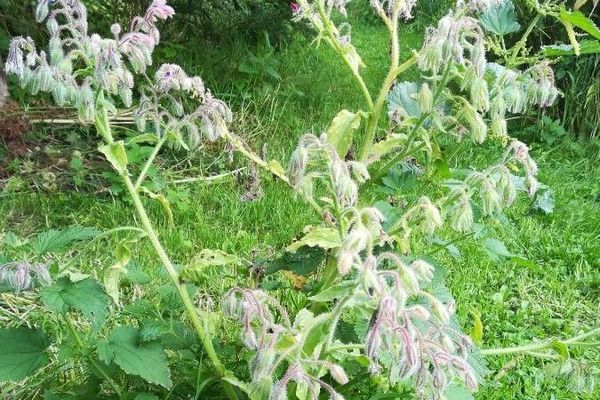
Beebread
Borago officinalis
Родина: Boraginaceae • Рід: Borago
БагаторічнаСередньоДекоративна
Bloom Color: Blue. Main Bloom Time: Early fall, Late summer, Mid summer. Form: Irregular or sprawling.
Опис
Landscape Uses:Border, Foundation, Massing. A very easily grown plant, succeeding in ordinary garden soil, preferring a dry soil and a sunny position. It grows particularly well in loose, stony soils with some chalk and sand. Plants are tolerant of poor dry soils, though much bigger specimens are produced when the plants are growing in better conditions. Tolerates a pH in the range 4.8 to 8.3. Borage is often grown as a culinary plant in the herb garden[1, 7]. Although an annual, it usually maintains itself by self-sowing, sometimes in quite a prolific manner, as long as the soil is disturbed by hoeing etc[14, 188]. Plants often develop mildew when growing in dry conditions or towards the end of the growing season. Flowers are a deeper blue when grown in poorer soils. The flowers are rich in a sweet nectar and are very attractive to bees[7, 14, 20, 108, 244]. The growing plant is a good companion for strawberries, tomatoes, courgettes and most other plants[14, 201, 238]. It is said to deter Japanese beetle and tomato hornworms. Special Features:Edible, Fragrant foliage, Not North American native, Invasive, Naturalizing, Suitable for dried flowers, Extended bloom season in Zones 9A and above. The plant is heat tolerant in zones 12 through 1. (Plant Hardiness Zones show how well plants withstand cold winter temperatures. Plant Heat Zones show when plants would start suffering from the heat. The Plant Heat Zone map is based on the number of "heat days" experienced in a given area where the temperature climbs to over 86 degrees F (30°C). At this temperature, many plants begin to suffer physiological damage. Heat Zones range from 1 (no heat days) to 12 (210 or more heat days). For example Heat Zone. 11-1 indicates that the plant is heat tolerant in zones 11 through 1.) For polyculture design as well as the above-ground architecture (form - tree, shrub etc. and size shown above) information on the habit and root pattern is also useful and given here if available. The plant growth habit is a clumper with limited spread [1-2]. A self-seeding annual [1-2]. References Carbon Farming Information and Carbon Sequestration Information Temperature Converter Type a value in the Celsius field to convert the value to Fahrenheit: Celsius Fahrenheit: The PFAF Bookshop Plants For A Future have a number of books available in paperback and digital form. Book titles include Edible Plants , Edible Perennials , Edible Trees , Edible Shrubs , Woodland Gardening , and Temperate Food Forest Plants . Our new book is Food Forest Plants For Hotter Conditions (Tropical and Sub-Tropical) . Shop Now
Походження та ареал
TEMPERATE ASIA: Lebanon, Syria,Cyprus. EUROPE: Sweden, Belarus, Lithuania, Latvia, Moldova, Albania, Greece (incl. Crete), Croatia, Italy (incl. Sardinia, Sicily), Spain (incl. Baleares), France (incl. Corsica), Portugal, AFRICA: Algeria (north), Libya (north), Morocco, Tunisia.
Корисні властивості
Edible Parts: Flowers Leaves Oil Edible Uses: Colouring Oil Tea Leaves - raw or cooked[2, 5, 7, 14, 115, 183]. They can be used as a pot-herb or be added to salads. They are also added whole as a flavouring to various drinks such as Pimms and wine-based drinks. The leaves are rich in potassium and calcium, they have a salty cucumber flavour. Very hairy, the whole leaves have an unpleasant feeling in the mouth and so they are best chopped up finely and added to other leaves when eaten in a salad[K]. The leaves should always be used fresh, because they lose their flavour and colour if dried. Flowers - raw. They are used as a decorative garnish on salads and summer fruit drinks[2, 5, 7, 14, 183]. The flowers are very nice, both to look at and to taste with a sweet slightly cucumber-like flavour[K]. A refreshing tea is made from the leaves and/or the flowers[21, 183]. The dried stems are used for flavouring beverages. The seed yields 30% oil, 20% of which is gamma-linolenic acid. Total yields are 0.35 - 0.65 tonnes per hectare. Unfortunately, the seed ripens intermittently over a period of time and falls from the plant when it is ripe, this makes harvesting the seeds in quantity very difficult[K]. An edible blue dye can be obtained from the flowers. It is used to colour vinegar. References More on Edible Uses
Поради
Seed - sow April/May in situ. The plants quickly develop a stout tap-root and do not transplant successfully. The seed can also be sown in situ in the autumn, this will produce larger plants and earlier flowering. The plant usually self-sows prolifically.