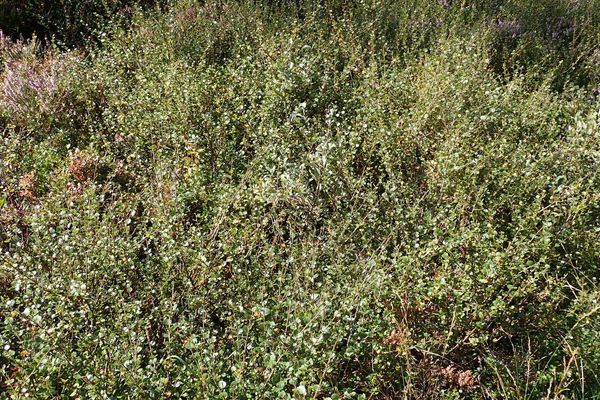
Arctic dwarf birch
Betula nana
Родина: Betulaceae • Рід: Betula
БагаторічнаСередньоДекоративна
вид рослин
Опис
Succeeds in a well-drained loamy soil in a sheltered position[11, 200]. Grows well in heavy clay soils. Grows well in moist places or the heath garden. Shade tolerant. This species is native to areas with very cold winters and often does not do well in milder zones. It can be excited into premature growth in mild winters and this new growth is susceptible to frost damage. Hybridizes freely with other members of this genus. Trees are notably susceptible to honey fungus. References Carbon Farming Information and Carbon Sequestration Information Temperature Converter Type a value in the Celsius field to convert the value to Fahrenheit: Celsius Fahrenheit: The PFAF Bookshop Plants For A Future have a number of books available in paperback and digital form. Book titles include Edible Plants , Edible Perennials , Edible Trees , Edible Shrubs , Woodland Gardening , and Temperate Food Forest Plants . Our new book is Food Forest Plants For Hotter Conditions (Tropical and Sub-Tropical) . Shop Now
Походження та ареал
TEMPERATE ASIA: Russian Federation-Western Siberia (Western Siberia), Russian Federation (Krasnoyarsk, Yakutia-Sakha), Russian Federation (Kamcatskij kraj) NORTHERN AMERICA: Canada (Northwest Territories, Yukon, Saskatchewan, Alberta, Manitoba, British Columbia), Greenland, United States (Alaska) EUROPE: Finland, United Kingdom, Iceland, Norway, Svalbard and Jan Mayen, Sweden, Austria, Switzerland, Czech Republic, Germany, Poland, Russian Federation (European part), Estonia, Lithuania, Latvia, I
Корисні властивості
Edible Parts: Flowers Leaves Edible Uses: Condiment Young leaves and catkins - raw. The buds and twigs are used as a flavouring in stews. References More on Edible Uses
Поради
Seed - best sown as soon as it is ripe in a light position in a cold frame[78, 80, 113, 134]. Only just cover the seed and place the pot in a sunny position[78, 80, 134]. Spring sown seed should be surface sown in a sunny position in a cold frame[113, 134]. If the germination is poor, raising the temperature by covering the seed with glass can help. When they are large enough to handle, prick the seedlings out into individual pots and grow them on in a cold frame for at least their first winter. Plant them out into their permanent positions in late spring or early summer, after the last expected frosts. If you have sufficient seed, it can be sown in an outdoor seedbed, either as soon as it is ripe or in the early spring - do not cover the spring sown seed. Grow the plants on in the seedbed for 2 years before planting them out into their permanent positions in the winter[78, 80, 113, 134].