Опис
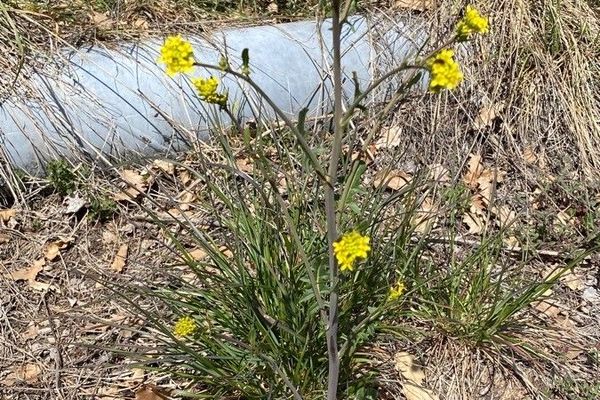
Identification & Habit: Biennial to short-lived perennial; glabrous. Basal leaves pinnate with fewer lobes than B. verna; upper leaves clasping and lobed. Bright yellow 4-petaled flowers in racemes. Siliques 2–5 cm, rounded-tetragonal, typically with a distinct beak to ~3 mm (key difference from B. orthoceras). Plants often form colonies along wet ditches and stream edges. Succeeds in sun or shade in a moist well-drained soil[1, 111]. Tolerates a pH in the range 4.8 to 7.5. The plant can continue to grow all winter, especially if the weather is mild. A short-lived perennial, though plants usually self-sow freely when in a suitable position[K]. There is at least one named form, developed for its ornamental value. 'Variegata' has variegated leaves and grows less strongly than the type. A good bee plant. Cultivar/Selection Notes: No named horticultural cultivars for wild use; culinary seed is sold as wintercress/yellow rocket. Some strains are slightly broader-leafed and milder. Pests & Problems: Flea beetles, aphids, sporadic cabbageworms; diseases include white rust (Albugo candida), downy mildew, and leaf spots in wet springs. Heat causes rapid bolting. References Carbon Farming Information and Carbon Sequestration Information Temperature Converter Type a value in the Celsius field to convert the value to Fahrenheit: Celsius Fahrenheit: The PFAF Bookshop Plants For A Future have a number of books available in paperback and digital form. Book titles include Edible Plants , Edible Perennials , Edible Trees , Edible Shrubs , Woodland Gardening , and Temperate Food Forest Plants . Our new book is Food Forest Plants For Hotter Conditions (Tropical and Sub-Tropical) . Shop Now
Походження та ареал
TEMPERATE ASIA: Afghanistan, Iran, Iraq, Turkey, Russian Federation-Ciscaucasia (Ciscaucasia), Armenia, Azerbaijan, Georgia, Russian Federation (Dagestan), Russian Federation-Western Siberia (Western Siberia), Russian Federation-Eastern Siberia (Eastern Siberia (southwest)), Kazakhstan, Kyrgyzstan, Tajikistan, Turkmenistan, Mongolia, China (Heilongjiang Sheng, Jiangsu Sheng, Jilin Sheng, Xinjiang Uygur Zizhiqu), Japan (Hokkaidô, Honshu, Kyushu, Ryukyu Islands, Shikoku) TROPICAL ASIA: India (Sikk
Корисні властивості
Edible Parts: Flowers Leaves Edible Uses: Young leaves - raw or cooked like spinach[2, 9, 27, 46, 52, 95]. A hot cress-like flavour. Young leaves are chopped up finely and added to salads, older leaves can be used as a potherb but they are rather strong and are best cooked in one or two changes of water. The leaves are available all year round, even in the winter, especially if the weather is mild[95, 115]. To increase the productivity of the plants, remove the flowering stems as they appear (they can be eaten like the leaves[K]) and pick the outer leaves as the plant regrows. Some caution is advised, see the notes above on toxicity. Young flowering stems - harvested before the flowers open and cooked like broccoli. Foraging: Leaves (raw in small amounts; best cooked), pre-bloom shoots/buds as raab. Flowers are garnish-edible. Edibility rating: 3/5 (reliable pot-herb; quality depends on youth and site) [2-3]. Raw: peppery/mustardy, “relatively mild” versus other wild mustards but still assertive. Briefly boil (2–3 min) or blanch and then sauté yields savory, mildly bitter greens and a vibrant, yellow-green broth ideal for soups/grains. Mix with fat (olive oil, butter) and acid (lemon/vinegar). Tight buds stir-fry well. Avoid roadside or fertilized edges that can intensify harshness [2-3]. Seasonality (Phenology): Rosettes: autumn–early spring. Harvest greens: early–mid spring (best pre-bolt). Flower/seed: late spring–early summer; palatability declines after full bloom. Seed set: early/mid summer. Look-Alikes & Confusion Risks: Other yellow-flowered mustards (Sinapis/Brassica, Rorippa, Descurainia), and edible upland cress (B. verna). Confirm glabrous plant, clasping upper leaves, and siliques with ~=3 mm beak. Not to be confused with toxic buttercups (5+ petals, different fruit) or hemlock (umbels, not racemes). Traditional/Indigenous Use Summary: Primarily a European potherb adopted by settlers in North America; in many regions it served as a spring tonic green. Limited indigenous North American food records compared with other native mustards. References More on Edible Uses
Поради
Seed - sow spring or autumn in situ. Germination usually takes place within 2 - 3 weeks. Division in spring. his plant is a short-lived perennial, and also usually self-sows freely, so we have not found division to be worthwhile.