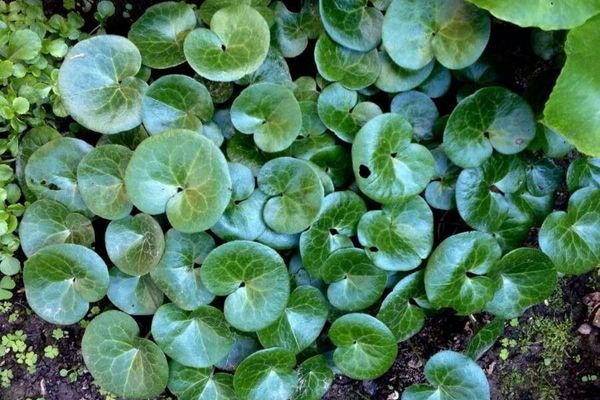
Asarabacca
Asarum europaeum
Родина: Aristolochiaceae • Рід: Asarum
БагаторічнаСередньоДекоративна
Bloom Color: Purple. Main Bloom Time: Early spring, Late spring, Mid spring. Form: Spreading or horizontal.
Опис
Landscape Uses:Border, Ground cover, Massing, Rock garden, Woodland garden. Prefers a rich moist neutral to acid soil in woodland or a shady position in the rock garden[1, 200]. Other reports say that this plant prefers a calcareous soil[13, 19, 268]. Plants are hardy to at least -15°c. The flowers are malodorous and are pollinated by flies. The root has a pungent, aromatic smell like mild pepper and ginger mixed, but more strongly aromatic. Plants often self-sow when growing in a suitable position. This plant was at one time commonly cultivated as a medicinal herb. Special Features: Attractive foliage, Not North American native, Naturalizing, Inconspicuous flowers or blooms. References Carbon Farming Information and Carbon Sequestration Information Temperature Converter Type a value in the Celsius field to convert the value to Fahrenheit: Celsius Fahrenheit: The PFAF Bookshop Plants For A Future have a number of books available in paperback and digital form. Book titles include Edible Plants , Edible Perennials , Edible Trees , Edible Shrubs , Woodland Gardening , and Temperate Food Forest Plants . Our new book is Food Forest Plants For Hotter Conditions (Tropical and Sub-Tropical) . Shop Now
Походження та ареал
TEMPERATE ASIA: Turkey (n.w. & n.e.), Georgia, Russian Federation-Western Siberia (Western Siberia (south)) EUROPE: Finland (south), Austria, Belgium, Switzerland, Czech Republic, Germany, Hungary, Poland, Slovakia, Russian Federation (European part), Belarus, Estonia, Lithuania, Latvia, Moldova, Ukraine (incl. Krym), Albania, Bulgaria, Bosnia and Herzegovina, Greece (north), Croatia, Italy, North Macedonia, Montenegro, Romania, Serbia, Slovenia, France
Корисні властивості
None known References More on Edible Uses
Поради
Seed - best sown in a cold frame as soon as it is ripe in the summer. Stored seed will require 3 weeks cold stratification and should be sown in late winter. The seed usually germinates in the spring in 1 - 4 or more weeks at 18°c. When large enough to handle, prick the seedlings out into individual pots and grow them on in light shade in the greenhouse for at least their first winter. Plant them out when large enough in late spring. Division in spring or autumn. Plants are slow to increase. It is best to pot the divisions up and keep them in light shade in the greenhouse until they are growing away strongly.