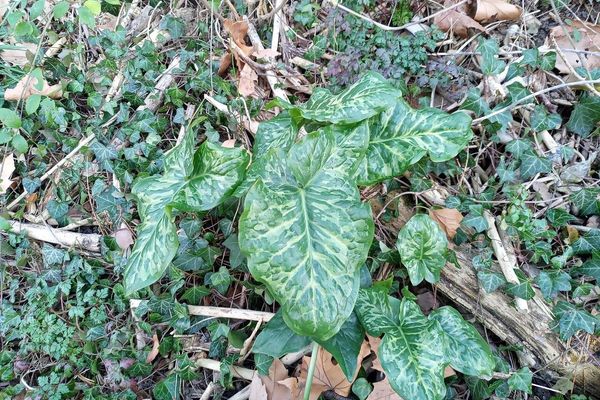
Italian arum
Arum italicum
Родина: Araceae • Рід: Arum
БагаторічнаСередньоДекоративна
Taxonomic Note: This genus was formerly classified in the family Lemnaceae. Modern classifications include it within the Araceae. Bloom Color: Orange. Main Bloom Time: Late spring, Mid spring. Form: Upright or erect.
Опис
Landscape Uses:Border, Container, Rock garden, Woodland garden. Prefers a humus rich soil and abundant water in the growing season. Succeeds in sun or dry shade, preferring a shady position[4, 17, 31] and growing well in woodland conditions. A polymorphic species, the British form has been separated off by some botanists as A. neglectum. The leaves appear in the autumn, the plant staying green all winter[1, K]. The inflorescence has the remarkable ability to heat itself above the ambient air temperature to such a degree that it is quite noticeable to the touch. This probably protects the flowers from damage by frost, or allows it to penetrate frozen ground. Members of this genus are rarely if ever troubled by browsing deer. Special Features:Attractive foliage, Naturalizing, All or parts of this plant are poisonous. References Carbon Farming Information and Carbon Sequestration Information Temperature Converter Type a value in the Celsius field to convert the value to Fahrenheit: Celsius Fahrenheit: The PFAF Bookshop Plants For A Future have a number of books available in paperback and digital form. Book titles include Edible Plants , Edible Perennials , Edible Trees , Edible Shrubs , Woodland Gardening , and Temperate Food Forest Plants . Our new book is Food Forest Plants For Hotter Conditions (Tropical and Sub-Tropical) . Shop Now
Походження та ареал
TEMPERATE ASIA: Turkey (n.e. & n.w.), Russian Federation-Ciscaucasia (Ciscaucasia), Armenia, Georgia EUROPE: United Kingdom (south), Switzerland, Russian Federation-European part (European part (southwest)), Ukraine (incl. Krym), Former Yugoslavia, Albania, Bulgaria, Greece (incl. Crete), Italy (incl. Sardinia, Sicily), Spain (incl. Baleares), France (incl. Corsica), Portugal AFRICA: Spain (Canarias), Portugal (Madeira Islands), Algeria (north), Morocco (north), Tunisia (north)
Корисні властивості
Edible Parts: Root Edible Uses: Tuber - cooked and used as a vegetable[2, 177]. An arrowroot can be extracted from the dried root. The root must be thoroughly dried or cooked before being eaten, see the notes above on toxicity. References More on Edible Uses
Поради
Seed - best sown in a greenhouse or cold frame as soon as it is ripe. The seed usually germinates in 1 - 6 months at 15°c. Stored seed should be sown in the spring in a greenhouse and can be slow to germinate, sometimes taking a year or more. A period of cold stratification might help to speed up the process. Sow the seed thinly, and allow the seedlings to grow on without disturbance for their first year, giving occasional liquid feeds to ensure that they do not become mineral deficient. When the plants are dormant in the autumn, divide up the small corms, planting 2 - 3 in each pot, and grow them on in light shade in the greenhouse for a further year, planting out when dormant in the autumn. Division of the corms in summer after flowering. Larger corms can be planted out direct into their permanent positions, though it is best to pot up the smaller corms and grow them on for a year in a cold frame before planting them out.