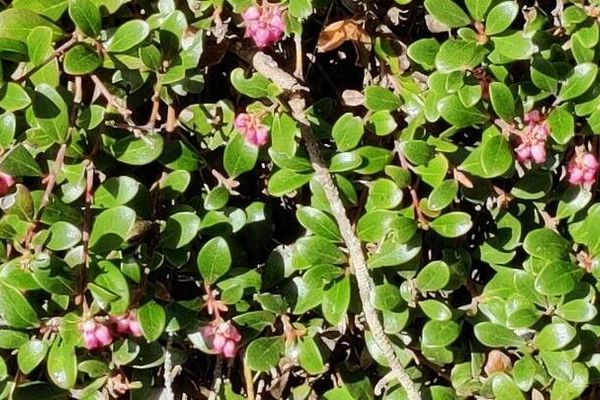
Опис
Requires a deep moist well-drained light or medium lime-free loam in sun or semi-shade. Thrives in dry to low-moisture conditions once established. It is ideal for water-wise landscaping, sandy or rocky soils, and full sun[3, 11, 200]. One report says that this species succeeds in alkaline soils (a rather surprising comment considering the general needs of the genus - it is more likely that the plant can grow on limestone so long as the soil remains acid[K]). Shade tolerant but plants produce less fruit when they are grown in the shade. Prefers a cool damp position. A very ornamental plant, it is sometimes cultivated for its medicinal uses. There are a number of named varieties developed for their ornamental interest. The form 'Massachusetts' is an especially prostrate, free-flowering and free-fruiting form. 'Anchor Bay', 'Point Reyes' and 'Vulcan's Peak' have all been mentioned as good groundcover forms. This is one of the first plants to colonize bare and rocky ground and burnt over areas. It is often an indicator of poor soils in the wild. Plants resent root disturbance and should be placed in their final positions as soon as possible[11, 134]. Hybridizes with other members of this genus, especially A. columbiana. The plant is heat tolerant in zones 6 through 1. (Plant Hardiness Zones show how well plants withstand cold winter temperatures. Plant Heat Zones show when plants would start suffering from the heat. The Plant Heat Zone map is based on the number of "heat days" experienced in a given area where the temperature climbs to over 86 degrees F (30°C). At this temperature, many plants begin to suffer physiological damage. Heat Zones range from 1 (no heat days) to 12 (210 or more heat days). For example Heat Zone. 11-1 indicates that the plant is heat tolerant in zones 11 through 1.) For polyculture design as well as the above-ground architecture (form - tree, shrub etc. and size shown above) information on the habit and root pattern is also useful and given here if available. An evergreen. A clumping mat former. Forming a dense prostrate carpet spreading indefinitely [1-2]. The root pattern is flat with shallow roots forming a plate near the soil surface [1-2]. References Carbon Farming Information and Carbon Sequestration Information Temperature Converter Type a value in the Celsius field to convert the value to Fahrenheit: Celsius Fahrenheit: The PFAF Bookshop Plants For A Future have a number of books available in paperback and digital form. Book titles include Edible Plants , Edible Perennials , Edible Trees , Edible Shrubs , Woodland Gardening , and Temperate Food Forest Plants . Our new book is Food Forest Plants For Hotter Conditions (Tropical and Sub-Tropical) . Shop Now
Походження та ареал
TEMPERATE ASIA: Ciscaucasia, Eastern Siberia, Far East, Russian Federation-Eastern Siberia, Russian Federation-Far East, Russian Federation-Western Siberia, Western Siberia,Russian Federation-Ciscaucasia. EUROPE: Denmark, Finland, United Kingdom (U.K.), Ireland, Iceland, Norway, Sweden, Austria, Switzerland, Czech Republic, Germany, Netherlands, Poland, Slovakia, Russian Federation-European part, European part, Belarus, Estonia, Lithuania, Latvia, Ukraine, Albania, Bulgaria, Greece, Croatia, Ita
Корисні властивості
Edible Parts: Fruit Edible Uses: Tea Fruits are edible but bland and very astringent, with white sawdust-like pulp under red skins. Seeds are rock-hard and not softened by cooking. Despite this, the fruits were eaten by Native Americans fresh, dried, or in mixtures with other berries [2-3]. Fruit - raw or cooked[3, 7, 8, 62, 161, 257]. Insipid, dry and mealy[4, 101, 183], it becomes sweeter when cooked. Added to stews etc, it is a good source of carbohydrates. The fruit can also be cooked and eaten. They are used for preserves or made into jelly, marmalade, sauces and pastes. The ripe fruit can be soaked in water or butter to reduce the dryness. Plants are best harvested after the first frost which sweetens them. They can be left to lie all winter under the snow. [1-4]. The fruit can also be used to make a cooling drink or used for preserves etc[161, 183]. It can be dried and stored for later use. The fruit is about 6mm in diameter. A tea is made from the dried leaves[177, 183]. References More on Edible Uses
Поради
Seed - best sown in a greenhouse as soon as it is ripe. Pre-soak dried seed in boiling water for 10 - 20 seconds or burn some straw on top of them and then stratify at 2 - 5°c for 2 months[11, 200]. The seed usually germinates in 2 - 3 months at 15°c. When large enough to handle, prick the seedlings out into individual pots and grow them on in a cold frame or greenhouse for at least their first winter. Plant out in late spring or early summer. Cuttings of side shoots of the current season's growth, 5 - 8cm with a heel, August to December in a frame. The cuttings are very slow and can take a year to root[1, 78]. Division in early spring. Take care because the plant resents root disturbance. Pot the divisions up and keep them in a lightly shaded position in a cold frame or greenhouse until they are growing away actively. Layering of long branches in early spring[200, 238].