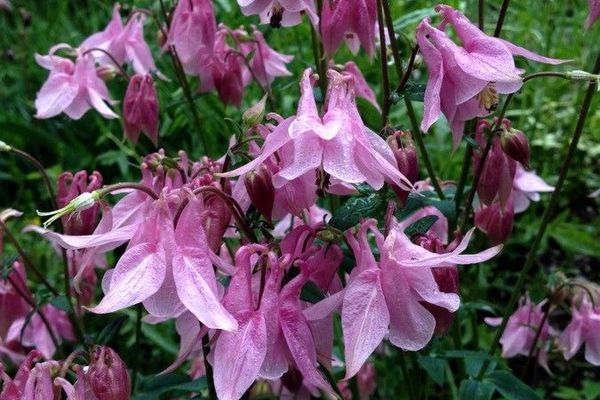
European columbine
Aquilegia vulgaris
Родина: Ranunculaceae • Рід: Aquilegia
БагаторічнаСередньоДекоративна
Bloom Color: Blue, Pink, Purple, Red, White. Main Bloom Time: Late spring.Form: Upright or erect.
Опис
Landscape Uses:Border, Rock garden, Woodland garden. Succeeds in ordinary garden soil, preferring a moist but not wet soil and a sunny position. Thrives in partial shade[1, 111]. Intolerant of heavy clay. Plants are hardy to at least -25°c. Whilst the blue-flowered forms of this species have no scent, white flowered forms have a soft clove scent in order to attract pollinating insects. Most species are short-lived, dying out after 2 - 3 years, though they usually produce seed prolifically. This species usually self-sows freely in the garden, it is very apt to hybridize with other members of the genus and usually becomes the dominant partner in any hybridization. Plants seem to be immune to the predations of rabbits. A greedy plant, inhibiting the growth of nearby plants, especially legumes[54, 201]. It also attracts red spider mites to the garden, these can then move on to other crops such as apples, pears and strawberries. It grows well with rhubarb. Special Features:Attracts birds, Not North American native, Naturalizing, All or parts of this plant are poisonous, Suitable for cut flowers. In garden design, as well as the above-ground architecture of a plant, root structure considerations help in choosing plants that work together for their optimal soil requirements including nutrients and water. The root pattern is fibrous dividing into a large number of fine roots [2-1]. References Carbon Farming Information and Carbon Sequestration Information Temperature Converter Type a value in the Celsius field to convert the value to Fahrenheit: Celsius Fahrenheit: The PFAF Bookshop Plants For A Future have a number of books available in paperback and digital form. Book titles include Edible Plants , Edible Perennials , Edible Trees , Edible Shrubs , Woodland Gardening , and Temperate Food Forest Plants . Our new book is Food Forest Plants For Hotter Conditions (Tropical and Sub-Tropical) . Shop Now
Походження та ареал
EUROPE: United Kingdom, Ireland, Austria, Belgium, Switzerland, Czech Republic, Germany, Hungary, Netherlands, Poland, Slovakia, Russian Federation-European part (European part (west)), Belarus, Estonia, Lithuania, Latvia, Ukraine (west), Albania, Bosnia and Herzegovina, Greece, Croatia, Italy (incl. Sicily), North Macedonia, Montenegro, Serbia, Slovenia, Spain, France (incl. Corsica), Portugal AFRICA: Algeria, Morocco
Корисні властивості
Edible Parts: Flowers Edible Uses: Tea Flowers - raw. Rich in nectar, they are sweet and delightful, they make a very attractive addition to mixed salads and can also be used as a thirst-quenching munch in the garden[K]. The flowers are also used as a tea substitute. References More on Edible Uses
Поради
Seed - best sown as soon as it is ripe in a cold frame. The seed can be slow to germinate. Stored seed can be sown in late winter in a cold frame. When large enough to handle, prick the seedlings out into individual pots and grow them on in a cold frame for their first winter. Plant out in late spring or early summer. Division in spring.