Bear garlic
Allium ursinum
Родина: Amaryllidaceae • Рід: Allium
БагаторічнаСередньоДекоративна
Taxonomic Note: This genus was formerly classified in the family Alliaceae. Modern classifications include it within the Amaryllidaceae.
Опис
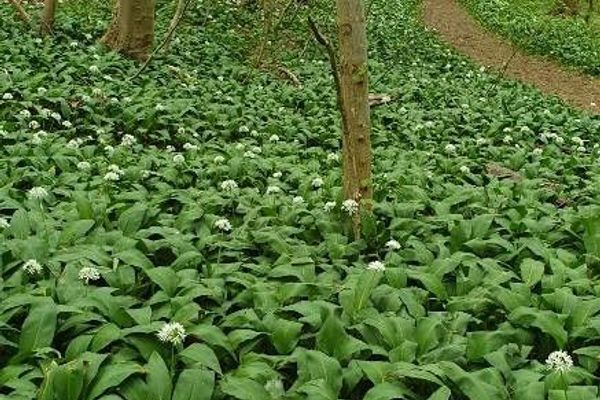
Prefers woodland conditions in a moist well-drained soil. Plants are often found in the wild growing in quite wet situations[K]. When growing in suitable conditions, wild garlic forms a dense carpet of growth in the spring and can be a very invasive plant[24, 203, K]. It dies down in early summer, however, allowing other plants to grow in the same space[K]. The bulbs should be planted fairly deeply. The seeds are dispersed by ants. Grows well with most plants, especially roses, carrots, beet and chamomile, but it inhibits the growth of legumes[18, 20, 54]. This plant is a bad companion for alfalfa, each species negatively affecting the other. Members of this genus are rarely if ever troubled by browsing deer. References Carbon Farming Information and Carbon Sequestration Information Temperature Converter Type a value in the Celsius field to convert the value to Fahrenheit: Celsius Fahrenheit: The PFAF Bookshop Plants For A Future have a number of books available in paperback and digital form. Book titles include Edible Plants , Edible Perennials , Edible Trees , Edible Shrubs , Woodland Gardening , and Temperate Food Forest Plants . Our new book is Food Forest Plants For Hotter Conditions (Tropical and Sub-Tropical) . Shop Now
Походження та ареал
TEMPERATE ASIA: Turkey, Russian Federation-Ciscaucasia (Ciscaucasia), Armenia, Azerbaijan, Georgia EUROPE: Denmark, Finland, United Kingdom, Ireland, Norway, Sweden, Czechoslovakia, Austria, Belgium, Switzerland, Germany, Hungary, Netherlands, Poland, Ukraine, Former Yugoslavia, Bulgaria, Greece, Italy (incl. Sicily), Romania, Spain, France (incl. Corsica)
Корисні властивості
Edible Parts: Flowers Leaves Root Edible Uses: Leaves - raw or cooked[2, 5, 9, 12, 24]. Usually available from late January[K]. One report says that they have an overpowering garlic odour that dissipates on cooking, though our experience is that they are considerably milder than garlic[K]. The leaves make a very nice addition to salads, and are especially welcome as a vital and fresh green leaf in the middle of winter[K]. Flowers - raw or cooked. These are somewhat stronger than the leaves, in small quantities they make a decorative and very tasty addition to salads[K]. The flowering heads can still be eaten as the seed pods are forming, though the flavour gets even stronger as the seeds ripen[K]. Bulb - raw or cooked. A fairly strong garlic flavour, though it is quite small and fiddly to harvest[K]. The bulbs can be harvested at any time the plant is dormant from early summer to early winter. Harvested in early summer, they will store for at least 6 months[K]. The bulbs can be up to 4cm long and 1cm in diameter. The small green bulbils are used as a caper substitute. References More on Edible Uses
Поради
Seed - best sown as soon as it is ripe either in situ or in a cold frame. It germinates quickly and can be grown on in the greenhouse for the first year, planting out the dormant bulbs in the late summer of the following year. Stored seed can be sown in spring in a greenhouse. Division in summer after the plants have died down. Very easy, the divisions can be planted out straight into their permanent positions.