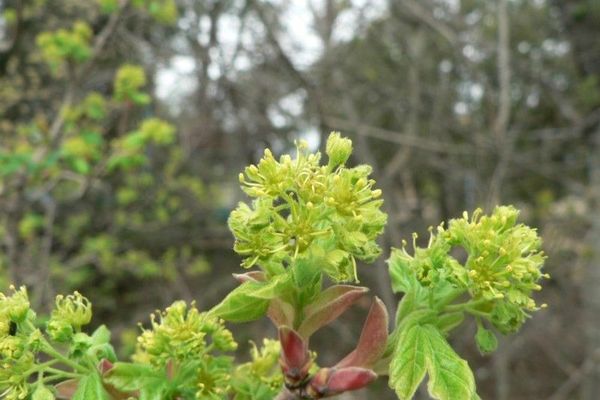
Field maple
Acer campestre
Родина: Sapindaceae • Рід: Acer
БагаторічнаСередньоДекоративна
Taxonomic Note: This genus was formerly classified in the family Aceraceae. Modern classifications include it within the Sapindaceae. Bloom Color: Green. Main Bloom Time: Early spring, Late spring, Mid spring. Form: Rounded.
Опис
Landscape Uses:Firewood, Pollard, Screen, Standard, Superior hedge, Specimen, Street tree. Of easy cultivation, it prefers a good moist well-drained soil in a sunny position but tolerates some shade[11, 200]. Does well on chalky soils, tolerating a pH as high as 8, but becoming a shrub in such conditions. Does not thrive in soils with a pH much below 6. Grows well in heavy clay soils. Tolerates atmospheric pollution. Growth is fast once the trees are established, but this later slows down and trees take about 50 years to reach maturity. Frequently found as a shrub in light woodland, especially under oak. It is one of the first trees to colonize chalk grassland. The field maple is a bad companion plant, inhibiting the growth of nearby plants[18, 20]. A good bee plant. This species has often been coppiced in the past for its wood. Trees produce seed in about 10 years from sowing. Special Features: Not North American native, Inconspicuous flowers or blooms. References Carbon Farming Information and Carbon Sequestration Information Temperature Converter Type a value in the Celsius field to convert the value to Fahrenheit: Celsius Fahrenheit: The PFAF Bookshop Plants For A Future have a number of books available in paperback and digital form. Book titles include Edible Plants , Edible Perennials , Edible Trees , Edible Shrubs , Woodland Gardening , and Temperate Food Forest Plants . Our new book is Food Forest Plants For Hotter Conditions (Tropical and Sub-Tropical) . Shop Now
Походження та ареал
TEMPERATE ASIA: Iran, Turkey, Russian Federation-Ciscaucasia (Ciscaucasia), Armenia, Azerbaijan, Georgia, Russian Federation (Dagestan) EUROPE: Denmark, United Kingdom, Sweden, Czechoslovakia, Austria, Belgium, Switzerland, Germany, Hungary, Netherlands, Poland, Russian Federation (European part), Moldova, Ukraine (incl. Krym),Former Yugoslavia, Albania, Bulgaria, Greece, Italy (incl. Sardinia, Sicily), Romania, Spain, France (incl. Corsica), Portugal AFRICA: Algeria, Tunisia
Корисні властивості
The sap contains a certain amount of sugar and can either be used as a drink, or can be concentrated into a syrup by boiling off the water. The concentration of sugar is considerably lower than in the sugar maples (A. saccharum). The syrup is used as a sweetener on many foods. The tree trunk is tapped in the early spring, the sap flowing better on warm sunny days following a frost. The best sap production comes from cold-winter areas with continental climates. References More on Edible Uses
Поради
Seed - best sown as soon as it is ripe in a cold frame, it usually germinates in the following spring. Pre-soak stored seed for 24 hours and then stratify for 2 - 4 months at 1 - 8°c. It can be slow to germinate. The seed can be harvested 'green' (when it has fully developed but before it has dried and produced any germination inhibitors) and sown immediately. It should germinate in late winter. If the seed is harvested too soon it will produce very weak plants or no plants at all[80, 113]. When large enough to handle, prick the seedlings out into individual pots and grow them on until they are 20cm or more tall before planting them out in their permanent positions. Layering, which takes about 12 months, is successful with most species in this genus. Cuttings of young shoots in June or July. The cuttings should have 2 - 3 pairs of leaves, plus one pair of buds at the base. Remove a very thin slice of bark at the base of the cutting, rooting is improved if a rooting hormone is used. The rooted cuttings must show new growth during the summer before being potted up otherwise they are unlikely to survive the winter.