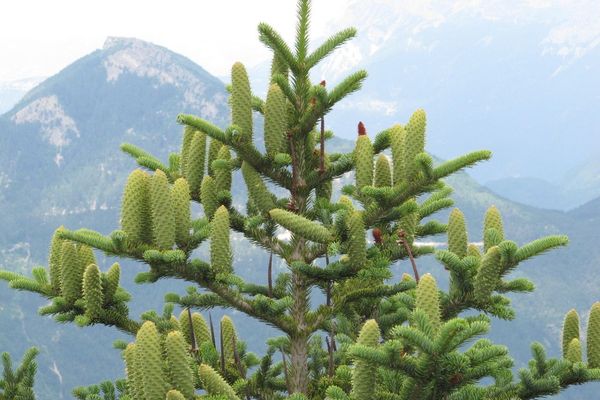
Christmastree
Abies alba
Родина: Pinaceae • Рід: Abies
БагаторічнаСередньоДекоративна
Form: Columnar.
Опис
Landscape Uses:Screen, Specimen. Prefers a good moist but not water-logged soil though it tolerates most soils except infertile sands and peats[11, 81]. Grows well in heavy clay soils. Prefers a slightly acid soil, with a pH down to about 5, and a north-facing slope. Plants are very shade tolerant and this species has often been used to underplant in forests[11, 81], but growth is slower in dense shade. Intolerant of atmospheric pollution. Requires a generous rainfall and a sheltered position[11, 81]. Intolerant of windy sites. The silver fir is a very hardy plant when dormant but it comes into growth in April and is then susceptible to damage by late frosts and aphis[185, 238]. This species is particularly subject to aphis infestation in many parts of the country, and is also prone to dieback and rust caused by fungal infections. Trees are slow growing for the first few years but from the age of around 6 years growth accelerates and height increases of 1 metre a year are not uncommon. Grows best in moist valleys in Scotland and in S.W. England where it often self-sows. This species also thrives in E. Anglia. Another report says that this species is not happy in the hot, dry, Lower Thames Valley, and does not thrive in many low-lying and frosty parts of southern England. It has been planted as a timber tree in northern and western Europe. It is also commonly used as a 'Christmas tree'[61, 200]. This tree is notably resistant to honey fungus[11, 81, 200]. Trees should be planted into their permanent positions when they are quite small, preferably between 30 and 90cm in height. Larger trees will check badly and hardly put on any growth for several years. This also badly affects root development and wind resistance. Unlike most species of conifers, this tree can be coppiced and will regenerate from the stump. Plants are strongly outbreeding, self-fertilized seed usually grows poorly. They hybridize freely with other members of this genus. The cultivar 'Pendula' used to be widely planted for ornament, shelter and timber but because it is now susceptible to damage by Adelges nordmannianae it is seldom planted. Research is going on (1975) to find provenances that are resistant. Special Features:Not North American native, There are no flowers or blooms. References Carbon Farming Information and Carbon Sequestration Information Temperature Converter Type a value in the Celsius field to convert the value to Fahrenheit: Celsius Fahrenheit: The PFAF Bookshop Plants For A Future have a number of books available in paperback and digital form. Book titles include Edible Plants , Edible Perennials , Edible Trees , Edible Shrubs , Woodland Gardening , and Temperate Food Forest Plants . Our new book is Food Forest Plants For Hotter Conditions (Tropical and Sub-Tropical) . Shop Now
Походження та ареал
EUROPE: Austria, Switzerland, Czech Republic, Germany, Hungary, Poland, Slovakia, Ukraine, Albania, Bulgaria, Bosnia and Herzegovina, Greece, Croatia, Italy, North Macedonia, Montenegro, Romania, Serbia, Slovenia, Spain, France (incl. Corsica)
Корисні властивості
Edible Parts: Inner bark Edible Uses: Inner bark - cooked. It is dried, ground into a powder and then used as a thickening in soups etc or mixed with cereals when making bread[105, 177]. References More on Edible Uses
Поради
Seed - sow early February in a greenhouse or outdoors in March. Germination is often poor, usually taking about 6 - 8 weeks. Stratification is said to produce a more even germination so it is probably best to sow the seed in a cold frame as soon as it is ripe in the autumn[80, 113]. The seed remains viable for up to 5 years if it is well stored. When large enough to handle, prick the seedlings out into individual pots and grow them on for at least their first winter in pots. Plant them out into their permanent positions in late spring or early summer, after the last expected frosts. Alternatively, if you have sufficient seed, it is possible to sow in an outdoor seedbed. One report says that it is best to grow the seedlings on in the shade at a density of about 550 plants per square metre whilst another report says that they are best grown on in a sunny position.